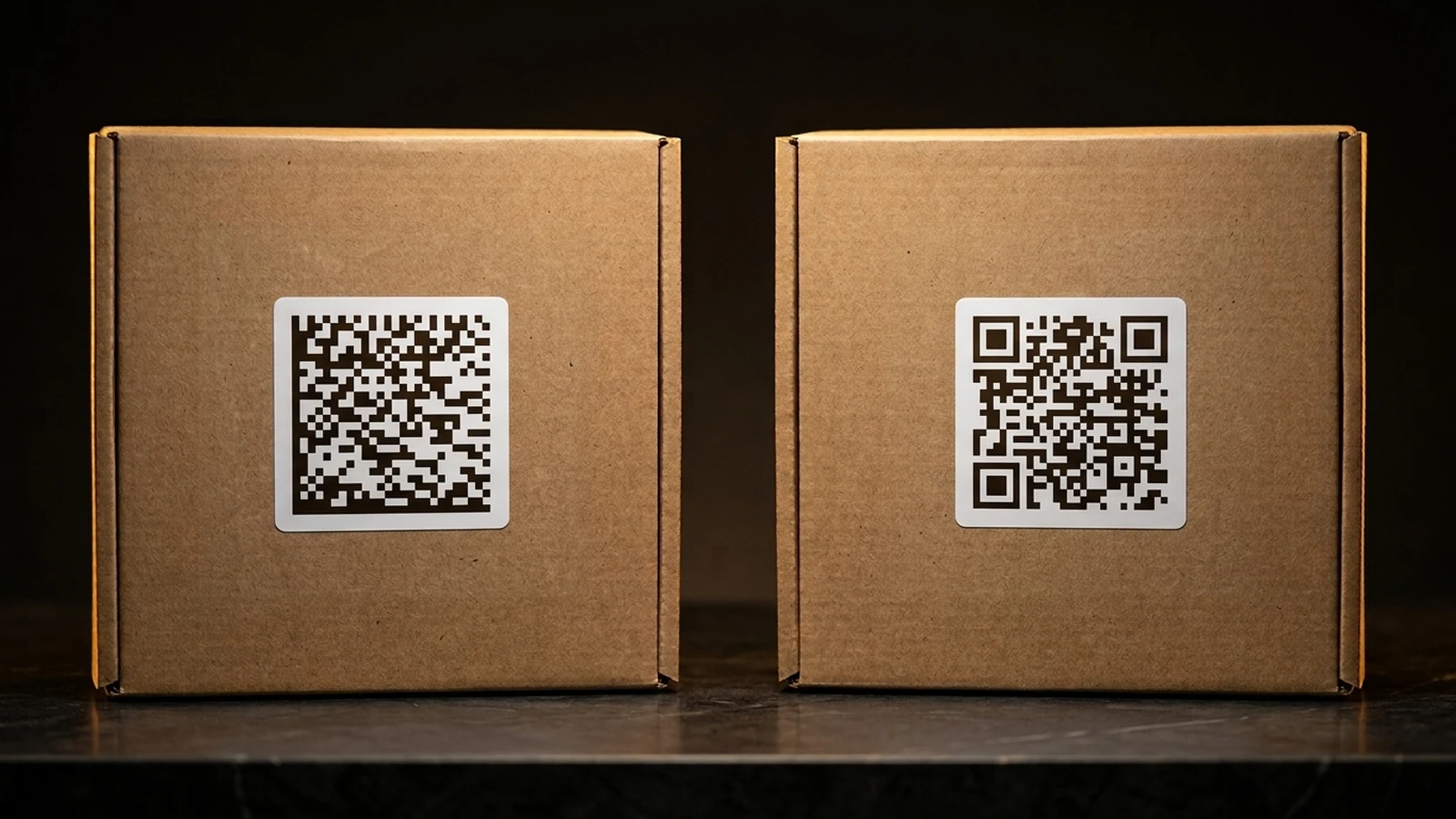
If you have ever compared a shipping label on an electronics component to a QR code on a restaurant menu, you have probably noticed they look different, even though both are small black-and-white squares packed with tiny cells. That difference is not cosmetic. Data Matrix and QR codes are both two-dimensional barcodes, but they were built for different jobs, they encode data differently under the hood, and they have ended up dominating almost opposite corners of the barcode world. Understanding where they overlap and where they diverge makes it much easier to pick the right one for whatever you are trying to label, track, or share.
This comparison covers what the two formats share, how they differ in capacity, physical size, visual structure, and error correction, and which one tends to make more sense for a given job. Neither format is objectively better than the other. They were designed to solve different problems, and in most cases the right choice is obvious once you know what those problems are.
What Do Data Matrix and QR Codes Actually Have in Common?
Both are matrix, or "area," barcodes rather than linear ones. A traditional 1D barcode, like the kind on a can of soup, encodes data along a single axis as a series of parallel bars and spaces of varying width. A matrix code encodes data across a two-dimensional grid instead, using the arrangement of small square cells, called modules, in both directions at once. That second dimension is what gives 2D codes like Data Matrix and QR so much more storage capacity for their physical size than a 1D barcode could ever achieve.
Both formats also build their own error correction directly into the symbol. Rather than relying on a perfectly clean scan every time, each code carries redundant data alongside the actual payload, calculated using Reed-Solomon error correction, the same general family of mathematics used to recover data from scratched CDs and DVDs. If part of the printed or displayed code gets smudged, torn, faded, or partially covered, a scanner can often still reconstruct the missing information from what is left and decode the code correctly. The exact mechanics differ between the two formats, which is covered in more detail further down, but the underlying idea, redundancy built into the symbol itself rather than bolted on afterward, is shared.
Finally, both are read the same general way: with a 2D imager, meaning a camera sensor that captures an actual image of the code and decodes it in software, rather than a classic 1D laser line-scanner that sweeps a single beam across a symbol. That includes dedicated industrial 2D scanners as well as ordinary smartphone camera apps. This is precisely why both formats can be read from almost any angle or rotation, something a laser line-scanner built for 1D barcodes cannot do at all, since there is no single line it could sweep across a two-dimensional grid that would capture the whole pattern.
Both formats also require a quiet zone, a margin of blank space surrounding the symbol, in order to decode reliably: four modules wide on every side for QR, only one module for Data Matrix, which is part of why Data Matrix fits in tighter spaces. A scanner uses the contrast between that empty margin and the symbol's border to confirm where the code starts and stops. Crop a Data Matrix or QR code too tightly, right up against other printed content or graphics, and even an otherwise perfect symbol can become difficult or impossible to read. This is a common, avoidable cause of scanning failures for both formats, not something specific to one or the other.
Where Did Each Format Come From, and Where Did It End Up Being Used?
QR codes were developed by Denso Wave, a Japanese company, in 1994. The original goal was narrow and practical: tracking automotive parts through a manufacturing and logistics process faster than the 1D barcodes of the time allowed. From that industrial starting point, QR codes went on to become the dominant consumer-facing 2D barcode worldwide, showing up on restaurant menus, marketing posters, event tickets, boarding passes, and payment screens. That shift happened largely because smartphone camera apps standardized around recognizing them, which made scanning a QR code something almost anyone with a phone could do without installing specialized software.
Data Matrix followed a different path. The format, standardized internationally as ISO/IEC 16022, was first developed at the end of the 1980s (the original patent was filed in 1988) and reworked into today's ECC 200 form in the mid-1990s. Rather than becoming a consumer-facing format, it became the dominant 2D barcode in industrial and business-to-business contexts: small parts marking, medical device labeling, aerospace and defense component traceability, electronics manufacturing, and pharmaceutical packaging. The reason comes down to physical size. Data Matrix supports a smaller minimum printed or etched footprint and higher data density per unit of area than QR, which matters enormously once you are labeling something only a few millimeters across, a scenario that comes up constantly in manufacturing but rarely in consumer marketing.
Which One Can Hold More Data?
On raw ceiling capacity, QR has the edge. The largest standard QR code, Version 40, uses a 177x177 module grid and can hold up to 7,089 numeric digits, 4,296 alphanumeric characters or 2,953 bytes, at its lowest error correction setting (ISO/IEC 18004). Data Matrix tops out lower: the largest standard square symbol, at 144x144 modules using ECC 200, holds up to 3,116 numeric digits, 2,335 alphanumeric characters or 1,556 bytes. So if you compare the two formats purely on maximum theoretical payload, QR wins by a wide margin.
In practice, that ceiling rarely matters. Almost no real-world application gets anywhere near either format's maximum capacity. A part number, a serial number, a tracking ID, a URL, or a GS1-formatted string with a product code and batch number typically runs from a handful of characters up to a few dozen, nowhere close to thousands. What tends to matter far more in practice is the other side of the tradeoff: how small can the symbol be printed while still holding the modest amount of data you actually need to encode. That is where Data Matrix compensates for its lower absolute ceiling, and it is the subject of the next section.
Which One Has a Smaller Minimum Size?
Data Matrix can be encoded in symbols as small as 10x10 modules. A standard QR code starts at 21x21 modules and needs a four-module quiet zone; even Micro QR, the compact variant, starts at 11x11 and is rarely supported by phone camera apps. QR's practical minimum size sits meaningfully larger because the format's three big corner finder patterns and its quiet zone requirements consume a larger fixed share of the available space at small sizes. Below a certain point, a QR code either cannot fit a useful payload at all or would need individual modules printed so small that ordinary marking and scanning equipment cannot reliably produce or read them.
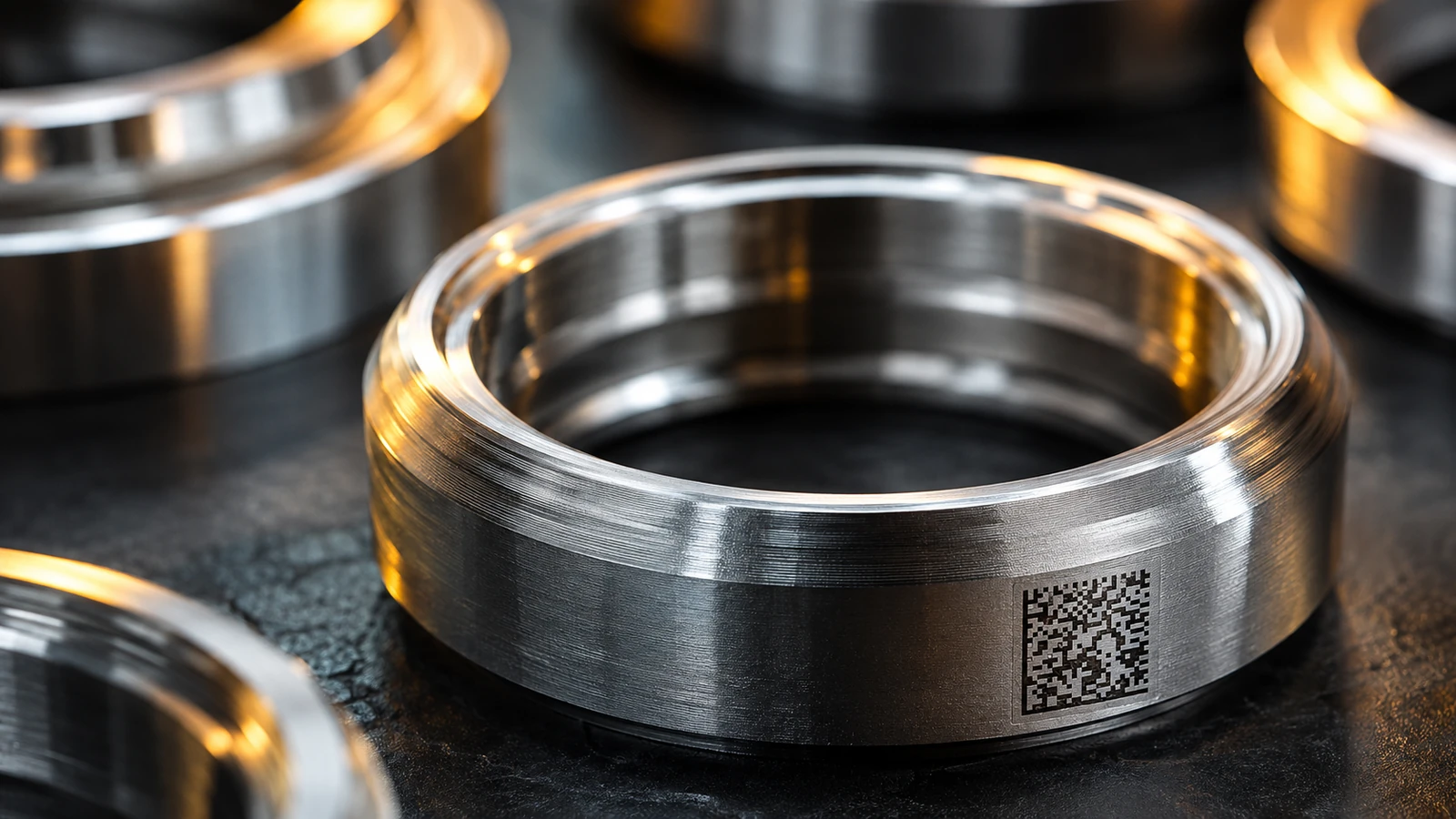
This size difference is the single biggest reason Data Matrix dominates tiny component marking. A printed circuit board, a surgical instrument, a small electronic connector, or an individual pill blister pack often has only a very small area of usable marking surface. A QR code frequently will not physically fit in that space at a data density that survives the printing or etching process intact. A Data Matrix code, by contrast, was engineered from the outset to work at that scale, and it shows in exactly which industries adopted it. Data density is a related but distinct idea worth separating out here: it is not just that Data Matrix can go smaller, it is that it packs more usable data into a given small area than QR can at the same physical size, which compounds the advantage in space-constrained labeling.
There is a related practical tradeoff worth knowing about, though: packing more data into a smaller physical footprint means each individual module gets smaller too, which raises the bar for whatever printer, laser marker, or dot-peen equipment is producing the code. A Data Matrix code pushed to its true minimum physical size has very small modules, and reproducing those modules cleanly demands fine print or marking resolution from the equipment producing it. In practice this is rarely a limiting factor for the industrial-grade equipment used in direct part marking, but it is a reminder that a smaller minimum size is not free. The tradeoff shows up in the equipment required to produce and read the code reliably, not in the format itself.
How Can You Tell Them Apart at a Glance?
Even without reading a single module, you can usually identify which format you are looking at just from its border, and this is one of the more genuinely useful facts to know if you work with either format regularly.
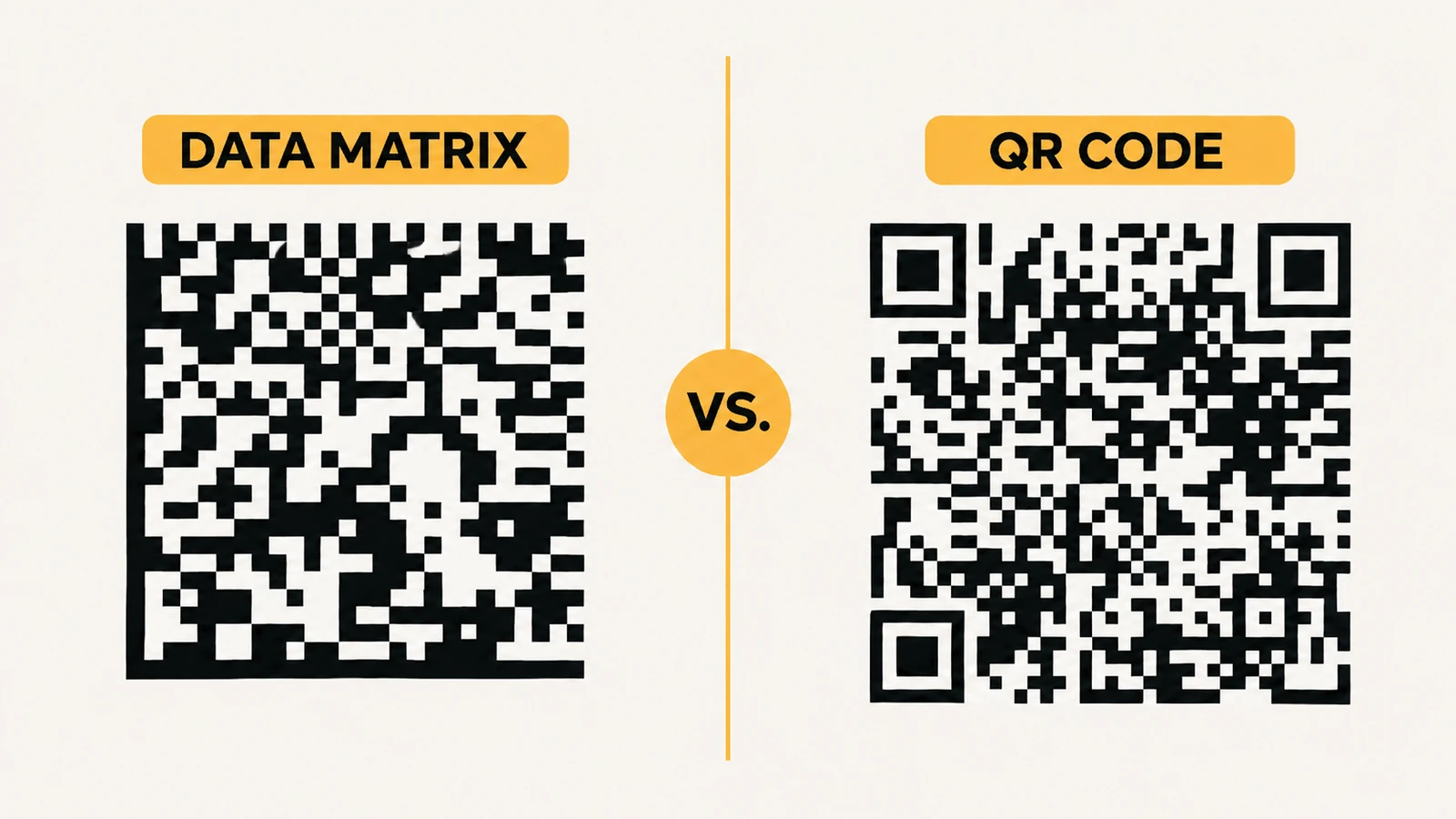
QR codes are recognizable by three large square finder patterns, positioned in three of the symbol's four corners, each looking like a smaller square nested inside a larger square outline. A scanner uses those three squares to detect the code's position and establish its orientation, since three corners is enough to determine the fourth geometrically. Larger QR versions also include smaller alignment patterns scattered through the interior of the grid, which help the scanner correct for any distortion, such as a code printed on a curved or slightly warped surface.
Data Matrix takes a different, more compact approach to the same problem. Instead of three separate corner squares, it uses a solid, unbroken "L"-shaped border running along two adjacent sides of the symbol. A scanner locates that solid L first, because it is the fastest way to find the code in a busy image and to determine which way it is oriented, even when the code has been printed or etched at an angle. The other two sides, opposite the solid L, use a different pattern entirely: an alternating sequence of light and dark modules, known as the clock track (also called the timing pattern), which tells the scanner exactly how many rows and columns make up the grid so it can divide the interior correctly before decoding the actual data.
The practical shortcut worth remembering: three corner squares means QR, a solid L-shaped border on two sides paired with an alternating checkerboard-style border on the other two means Data Matrix. Once you know to look for it, you can identify either format correctly from across a room.
How Do They Handle a Damaged or Dirty Code?
Both formats use Reed-Solomon error correction, but they offer it to the person generating the code in different ways, and it is worth describing that difference fairly rather than declaring one format simply more damage-resistant than the other.
QR codes offer four selectable error correction levels, commonly labeled L, M, Q, and H, which recover roughly 7 percent, 15 percent, 25 percent, and 30 percent of codewords respectively. Whoever generates the QR code chooses the level, trading data capacity for damage tolerance. A low level packs more data into a given symbol size but tolerates less damage before it becomes unreadable; a high level sacrifices some capacity in exchange for surviving more scratching, smudging, or partial obstruction. This tradeoff is explicit and adjustable every time a QR code is created.
Data Matrix's ECC 200 scheme also relies on Reed-Solomon codes, but the amount of error correction overhead is essentially fixed by the standard for a given symbol size, rather than something the person generating the code selects. You do not choose a damage-tolerance level the way you would with QR; the specification determines it for you based on how large the symbol is. ECC 200 reserves roughly 28 to 30 percent of a symbol's codewords for error correction in medium and large symbols, and a much higher share in the smallest ones; in practice that lets a scanner recover from roughly 15 to 25 percent of the codewords being damaged or obscured, depending on symbol size and on where the damage falls. The "30 percent" figure often quoted by vendors is a best case. The two formats are not directly comparable on a single damage-tolerance number, since QR's figure depends entirely on which of its four levels was chosen at creation time, while Data Matrix's is baked into the standard itself. What matters practically is that QR gives you a dial to turn, and Data Matrix gives you a fixed, standard-defined level of protection appropriate to its symbol size.
Which One Should You Actually Use?
The honest answer is that it depends on who is going to scan the code and what you are attaching it to, not on which format is generally "better." Each one clearly wins in the scenarios it was built for.
Scanning distance is another practical factor that quietly reinforces this split. QR codes are usually designed to be scanned from a comfortable arm's-length distance by a person holding a phone, so their larger finder patterns and typically larger printed size work in their favor. Data Matrix codes, especially the small ones used in part marking, are far more often read by a fixed-mount or handheld industrial scanner positioned just a few centimeters from the part, sometimes under controlled lighting, which is exactly the kind of setup that can resolve a much smaller, denser symbol reliably.
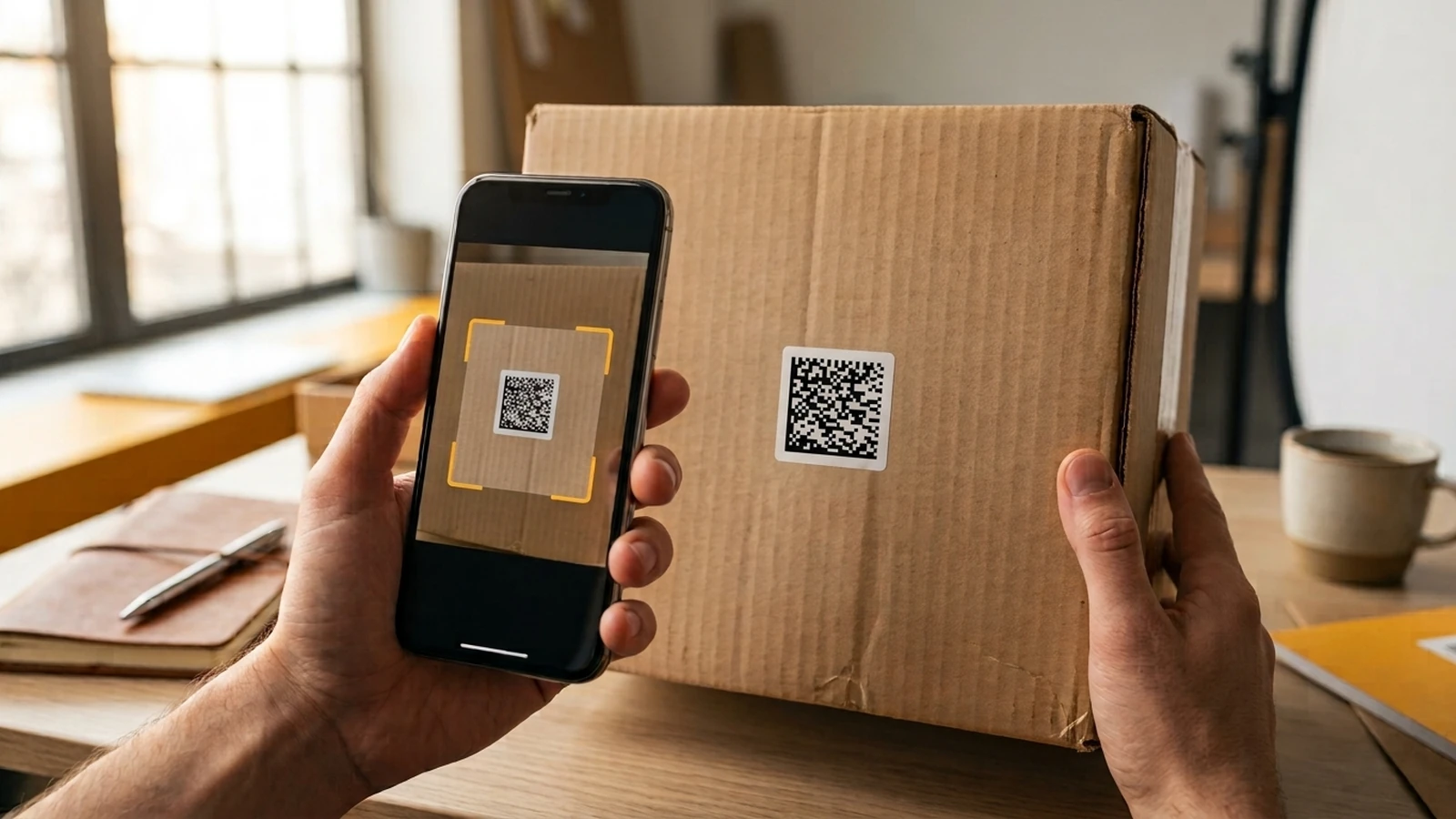
- QR tends to win for consumer-facing, print-and-scan situations: marketing materials, restaurant menus, event and travel tickets, payment prompts, and any other context where an ordinary person is going to scan the code with their own phone's camera app. Near-universal recognition by phone camera software and a comfortably larger scanning distance both favor QR here.
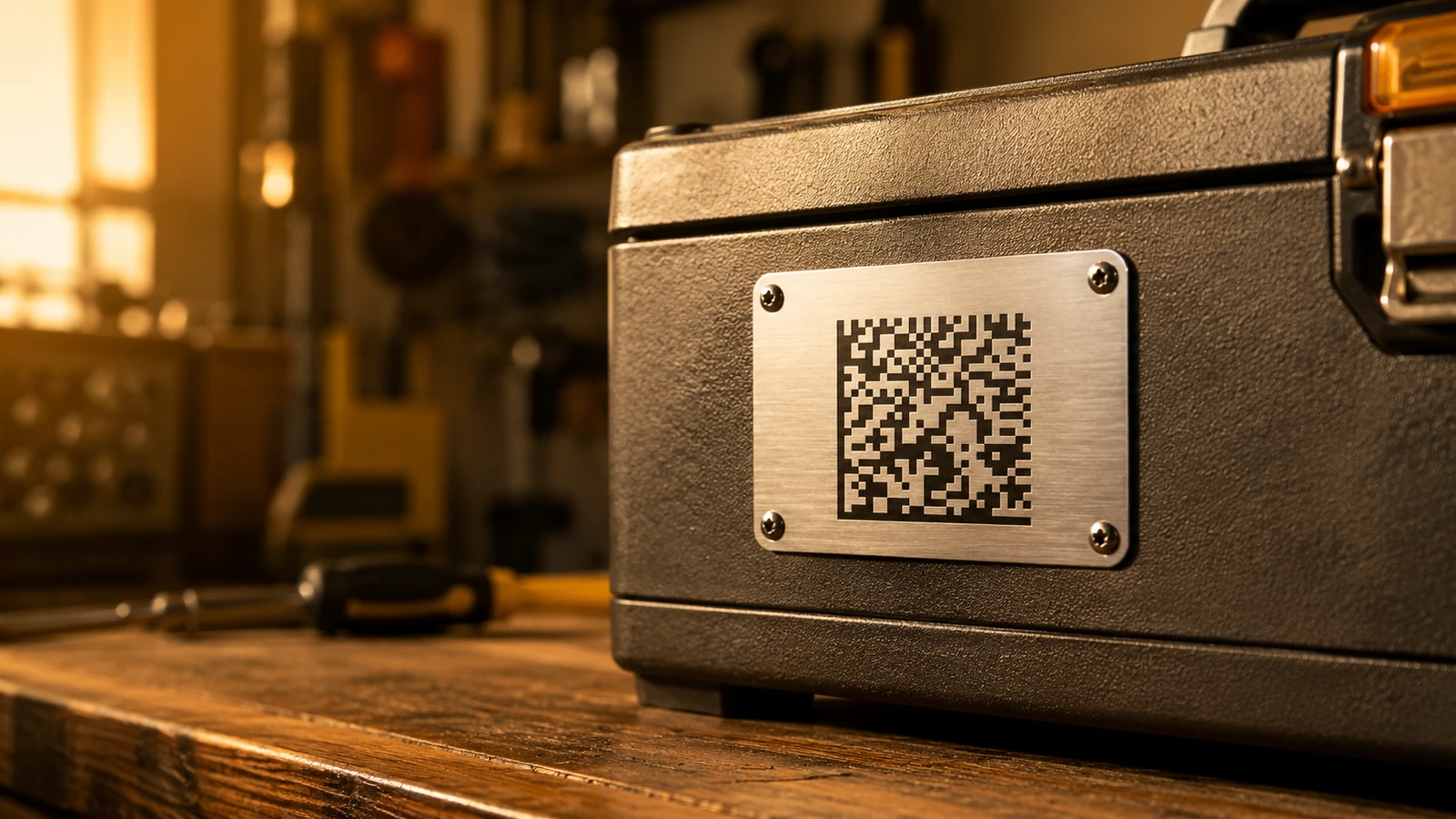
- Data Matrix tends to win for small, permanent, industrial marking: printed circuit boards, medical devices, aerospace and defense components, and any part that is going to be laser-etched or dot-peened directly onto metal or another durable surface. Its small minimum footprint and its long track record in direct part marking make it the practical default once the marking surface is small and the code needs to survive the part's entire service life.
- QR generally wins when maximum data capacity matters more than minimum size: very long payloads, such as embedded vCards or data-heavy links, sit comfortably within QR's much higher ceiling.
- Data Matrix generally wins when the marking surface itself is the binding constraint: if the physical space available to print or etch a code is only a few millimeters across, Data Matrix's smaller practical minimum size often makes it the only format that fits at all.
Neither format is a universal replacement for the other, and that is by design. QR was shaped by consumer scanning at a comfortable distance with a phone; Data Matrix was shaped by industrial marking on small, durable, permanent surfaces. Once you know which situation you are actually in, the choice tends to make itself.
If what you are working on is small-footprint, permanent, or industrial in nature, whether that is a component label, a batch code, or a part traceability marking, Data Matrix is very likely the right format, and you can generate one directly on this site by entering your text or data and downloading the resulting image.